
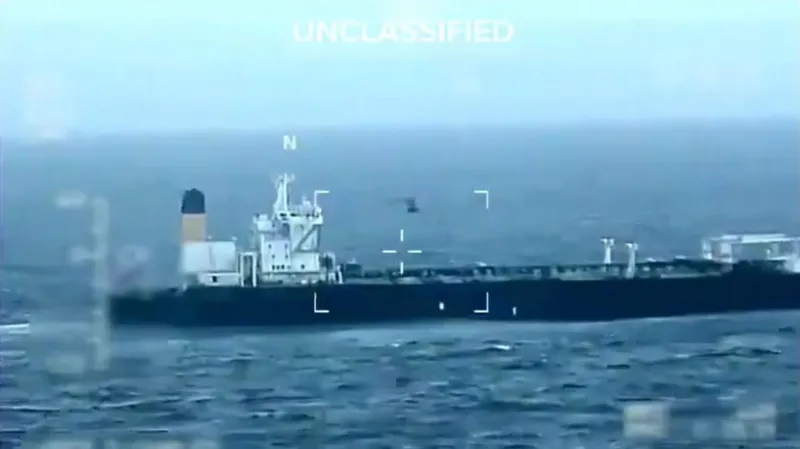
The United States has seized a second oil tanker off the coast of Venezuela this month, according to the US Department of Homeland Security. The tanker had recently departed from Venezuela and was intercepted in international waters during a Coast Guard-led operation.
The seizure follows President Donald Trump’s announcement earlier this week that he had ordered a “blockade” of sanctioned oil tankers entering and leaving Venezuela.
At Least 13 Photos Removed From US Justice Department Epstein Files Website↗
Operation Led by US Coast Guard
The operation was carried out by the US Coast Guard, with a specialised tactical boarding team deployed onto the vessel. Homeland Security Secretary Kristi Noem, whose department oversees the Coast Guard, shared a video of the seizure on social media platform X.
The footage shows US helicopters landing on the deck of a tanker with the name Centuries written on its side.
Tanker Identified as Panamanian-Flagged Vessel
According to shipping records reviewed by BBC Verify, the Centuries is currently Panamanian-flagged, though it has also sailed under the flags of Greece and Liberia over the past five years.
While the vessel itself is not listed on the US Treasury’s sanctions register, the White House later clarified that its cargo was sanctioned.
White House Deputy Press Secretary Anna Kelly stated that the tanker was carrying sanctioned oil belonging to PDVSA, Venezuela’s state-run oil company.
She described the ship as part of what the US calls Venezuela’s “shadow fleet”, allegedly used to traffic oil and finance President Nicolás Maduro’s government.
Venezuela Condemns Seizure as “Theft and Kidnapping”
Venezuela strongly condemned the seizure, calling it an act of “theft and kidnapping.” The Venezuelan government accused the Trump administration of attempting to steal the country’s natural resources.
In an official statement, Caracas warned that the action would not go unpunished and said it plans to file a complaint with the United Nations Security Council and other international bodies.
President Maduro has repeatedly rejected US allegations that his government is involved in criminal or terrorist activity.
Rising US Military Activity in the Caribbean
The seizure comes amid a broader US military buildup in the Caribbean Sea. In recent weeks, US forces have conducted strikes on alleged Venezuelan drug-smuggling boats, operations that reportedly resulted in around 100 deaths.
The US has not publicly released evidence confirming the vessels were transporting drugs, and the strikes have drawn increasing scrutiny from members of Congress.
The Trump administration has accused Maduro of leading a designated terrorist organisation known as the Cartel de los Soles, an accusation Venezuela firmly denies.
Trump Administration Defends Maritime Interdictions
President Trump has accused Venezuela of using “stolen” oil revenues to fund drug trafficking, human trafficking, violence, and other criminal activities.
Following the latest seizure, US Defence Secretary Pete Hegseth said the US would continue maritime interdiction operations to dismantle illicit networks in the region.
He stated that violence, drugs, and instability would not be allowed to dominate the Western Hemisphere.
Venezuela’s Oil Dependence and Growing Pressure
Venezuela holds the world’s largest proven oil reserves and relies heavily on oil exports to finance government spending. The seizures, combined with sanctions and the announced blockade, place additional economic pressure on the country.
The latest incident occurred less than a week after US authorities seized another tanker believed to be part of Venezuela’s so-called “ghost fleet”, which allegedly used deceptive shipping practices to avoid detection.
Conclusion
The seizure of a second oil tanker off Venezuela’s coast marks a significant escalation in US enforcement actions against Venezuela’s oil exports. While Washington frames the operations as necessary to disrupt sanctioned trade and criminal networks, Caracas views them as illegal acts of aggression. As diplomatic tensions rise and military activity increases in the Caribbean, the standoff threatens to deepen the already strained relationship between the two countries, with global energy markets and regional stability closely watching the outcome.