
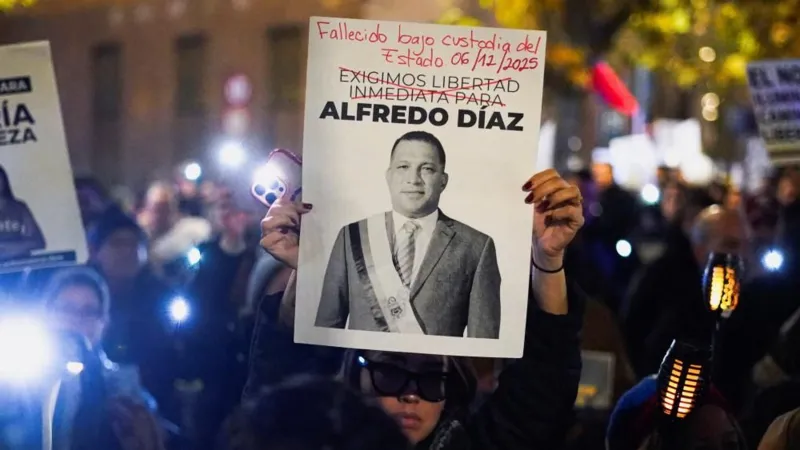
The United States has sharply condemned the death of Venezuelan opposition figure Alfredo Díaz, calling it a “reminder of the vile nature” of President Nicolás Maduro’s government. Díaz, 56, died after collapsing in his cell at El Helicoide prison, according to Venezuelan officials. Human rights groups and opposition leaders allege he was mistreated and arbitrarily detained.
Trump Raises Concerns Over $72 Billion Netflix–Warner Bros Deal: “Could Be a Problem”↗
Death in Custody Sparks International Outrage
Alfredo Díaz, a former governor of Nueva Esparta state and a prominent opposition voice, was held for over a year at El Helicoide, Venezuela’s most notorious detention facility. The Venezuelan government says Díaz showed signs of a heart attack and died after being rushed to hospital. However, human rights organizations dispute this account, describing El Helicoide as a torture site and claiming Díaz was kept in solitary confinement and denied regular family visits.
US Accuses Maduro Government of Abuse and Repression
The US State Department’s Bureau of Western Hemisphere Affairs said Díaz had been “arbitrarily detained” and held in a “torture centre.” Díaz was arrested in 2024 after challenging the results of the presidential election, which Venezuela’s government-controlled election council declared in Maduro’s favor. International observers widely rejected the election as fraudulent, and mass protests erupted across the country.
Opposition Leaders Condemn Pattern of Political Prisoner Deaths
According to Foro Penal, a leading Venezuelan human rights group, Díaz becomes the 17th political prisoner to die in custody since 2014. The organization’s president, Alfredo Romero, stated that Díaz was isolated for an entire year and allowed only one visit from his daughter. Nobel Peace Prize winner and opposition leader María Corina Machado, currently in hiding to avoid arrest, said Díaz’s death is part of a “painful chain” of deaths tied to post-election repression. The Democratic Unitary Platform and Díaz’s party, Democratic Action (AD), also condemned the government, saying he was unjustly detained without due process and denied basic human rights.
Growing Tensions Between the US and Venezuela
The death comes amid escalating hostility between the Trump administration and Maduro. The US has increased military presence in the region and carried out air strikes on boats it says are used for drug trafficking, killing more than 80 people. President Trump has accused Maduro of leading drug cartels such as the Cartel de los Soles and of “emptying prisons and insane asylums” into the US. Maduro has denied all allegations, accusing the US of using the drug war as a cover to topple his government and seize Venezuela’s oil reserves.
Regional Military Build-Up and Diplomatic Fallout
The US has launched its largest naval deployment in Latin America in decades, stationing thousands of troops in surrounding waters. Venezuela has responded by swearing in more than 5,600 soldiers, calling US actions a direct threat. Meanwhile, diplomatic tensions have spilled into air travel. Six airlines revoked landing rights in Caracas after a US warning of “heightened military activity.” However, in a rare positive development, Venezuela and Turkey agreed to resume Turkish Airlines flights between Caracas and Istanbul.
Conclusion
Alfredo Díaz’s death has intensified global scrutiny of Venezuela’s human rights situation and further fueled tensions between Washington and Caracas. As the US accuses Maduro’s administration of systemic abuse, repression, and corruption, Venezuelan authorities deny wrongdoing and accuse the US of imperialist ambitions. With military build-ups, diplomatic rifts, and rising political violence, relations between the two countries continue to deteriorate — leaving the fate of Venezuela’s political prisoners and opposition movement increasingly uncertain.