
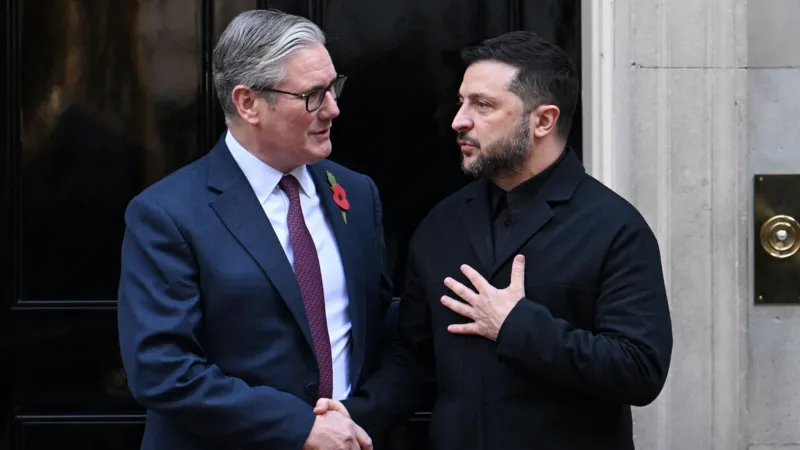
Ukrainian President Volodymyr Zelensky is set to meet UK Prime Minister Sir Keir Starmer, French President Emmanuel Macron, and German Chancellor Friedrich Merz in London on Monday.
The urgent talks come as Europe responds to pressure from the United States, which is pushing Kyiv to accept concessions in a possible peace deal with Russia.
Katy Perry Goes Instagram Official With Justin Trudeau During Japan Trip↗
Tensions Rise as US Pushes for Quick Agreement
The London summit follows intense three-day negotiations in Florida, where Zelensky’s new chief negotiator Rustem Umerov met with US officials to revise a proposed peace plan.
While both sides described the discussions as “constructive,” US President Donald Trump publicly criticised Zelensky for allegedly not reviewing the latest draft quickly enough.
Trump suggested the proposal was acceptable to Moscow but questioned whether Zelensky agreed, indicating lingering divisions over the terms.
Zelensky Awaits Briefing on Updated Peace Proposal
Zelensky confirmed he would be briefed by Umerov either in London or Brussels, emphasizing that certain sensitive issues must be discussed “in person” rather than over the phone.
He described recent talks with Trump advisers Steve Witkoff and Jared Kushner as “constructive, though not easy.”
Europe Seeks Strong Security Guarantees for Ukraine
Monday’s meeting brings together the three largest NATO defense spenders in Europe—the UK, France, and Germany.
Downing Street said discussions will focus on:
- The progress of peace negotiations
- Ensuring Ukraine’s ability to decide its own future
- Establishing meaningful security guarantees to deter future Russian aggression
UK Cabinet Minister Pat McFadden warned that any agreement must be backed by real enforcement measures, not a “toothless organisation.”
Coalition of the Willing: New Defence Support Framework
The UK and France have been leading efforts to form a “Multinational Force Ukraine”, a coalition of allied countries willing to provide long-term defense support.
While not a traditional peacekeeping mission, the force may offer reassurance and defensive assistance inside Ukraine—though Germany, Italy, and Poland remain cautious about placing troops on the ground.
US Plan Faces Resistance Over Territorial Concessions
One of the most contentious issues is the US proposal that Ukraine withdraw from parts of its eastern territories, which Russia has seized but not fully captured.
In exchange, Russia would withdraw from other areas and halt fighting.
Additionally, discussions around the Zaporizhzhia nuclear power plant remain deeply complex.
The plant, Europe’s largest, is under Russian control, and drafts of the US proposal suggest splitting future energy output between Russia and Ukraine.
US envoy Keith Kellogg said negotiations are nearing resolution but acknowledged that territorial issues and the nuclear plant remain major obstacles.
European Allies Fear US Deal May Favor Russia
European leaders worry that the US-led peace framework may prioritise speed over long-term security, potentially leaving the continent vulnerable.
Previous versions of the plan were widely criticised for being too favourable to Russia, prompting revisions.
Despite major military setbacks and economic strain, the Kremlin insists it will continue fighting until it controls all of Donetsk and Luhansk, where Russian forces currently hold about 85%.
Kremlin Praises US National Security Strategy
Adding to Europe’s concerns, Moscow welcomed the White House’s updated National Security Strategy, which calls for improved US-Russia relations and criticises Europe’s economic and migration policies.
The Kremlin said the US strategy is “largely consistent” with its own worldview.
Conclusion
As President Zelensky meets European leaders in London, the future of the Ukraine-Russia war hangs in the balance. The US is pushing for swift compromise, while Europe seeks stronger assurances that any peace deal will not embolden Moscow or weaken continental security. The coming days will determine whether Ukraine secures a sustainable long-term agreement—or faces pressure to accept concessions that could reshape Europe’s geopolitical landscape.